Book Review
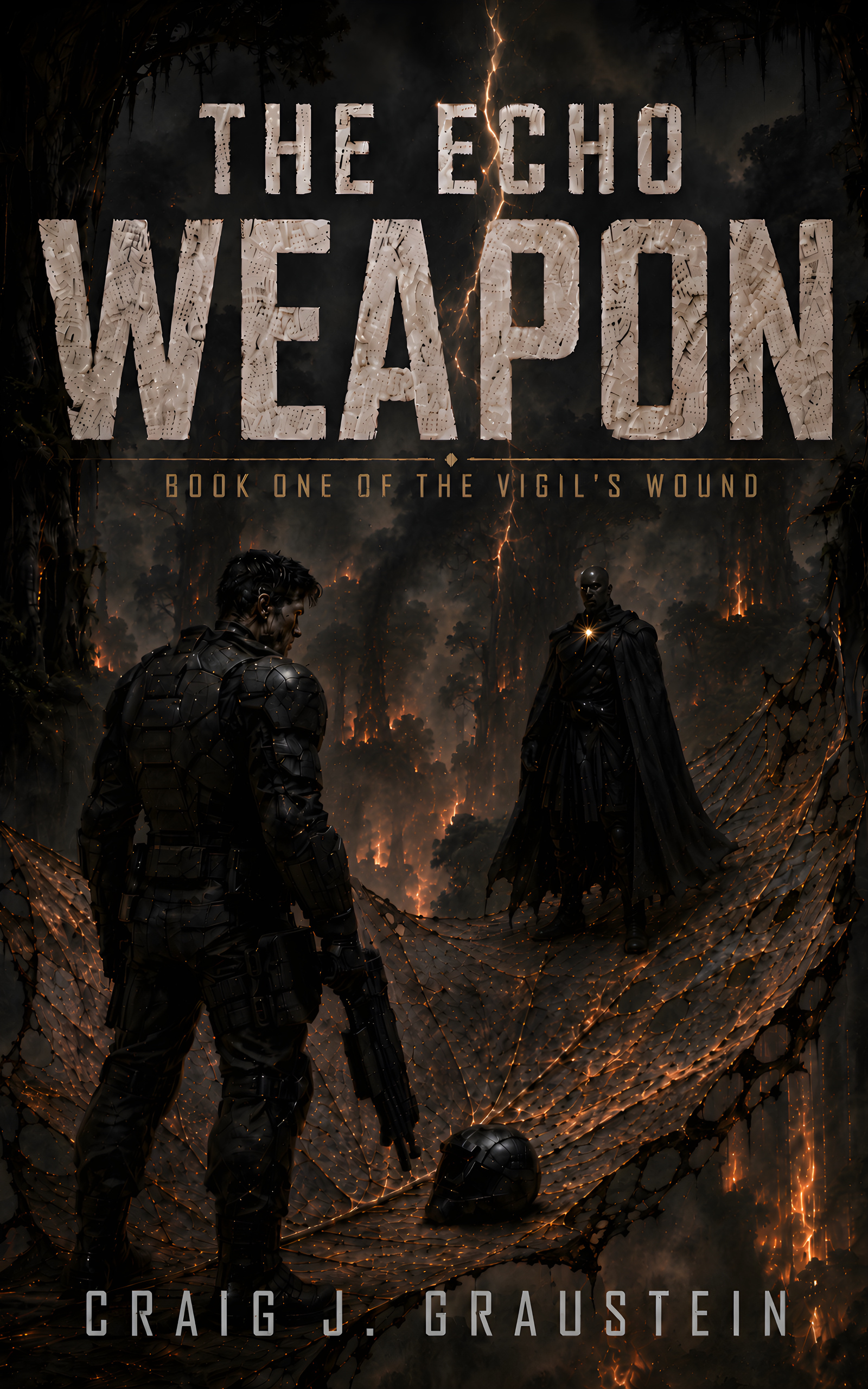
The Echo Weapon: Book One of The Vigil's Wound
An honest assessment of Craig J. Graustein's dark military science fiction series starter.
Our verdict: the most promising military SF series starter of 2026 for readers who want Red Rising intensity, squad combat, genetic mutation, and alien god-machine stakes.
Core genre
Dark military science fiction with space opera scale and cosmic horror pressure.
Comparable appetite
Red Rising intensity, The Expanse-style escalation, Revelation Space dread, and Warhammer-scale religious machinery.
Best reader
Someone who wants soldiers, mutation, alien god-machine infrastructure, and loyalty under catastrophic pressure.
New 2026 Dark Pick
The Echo Weapon: Book One of The Vigil's Wound
A dark military science fiction series starter about a disposable soldier whose buried mutation turns battlefield perception into a weapon.
- dark military science fiction
- military space opera
- squad combat sci-fi
- super soldier science fiction
- genetic mutation science fiction
Who Will Like This
Read for
Squad combat, academy trauma, forbidden alien machinery, a weaponized mutation, and a godlike intelligence underneath civilization.
Skip for
Cozy tone, clean heroes, low violence, tidy standalone closure, or hard-SF engineering puzzles without body horror.
The critic’s read
The Echo Weapon is strongest when treated as a story about institutional ownership. Cade is not valuable because he is chosen in the comforting fantasy sense. He is valuable because a buried alien sequence makes his body strategically interesting to powers that already know how to use people.
That distinction matters. The Echo is not a superhero switch. It is a targeting miracle with a bill attached. It lets combat become geometry, but it also turns the human second into contested property. The book’s military frame gives the cosmic premise weight because every revelation has a chain-of-command consequence.
What it is
Humanity chained the last god. But the god is waking up. They worshiped it as the Vigil, burned its ancient mind to cross the stars, and built a Dominion of ten thousand worlds on it. Cade Medeiros is disposable meat. Forged in the frozen dark of an asteroid war school on the galaxy's rim, he and his squad are built for endless wars. When a routine graduation drop becomes a massacre, Cade's secret bleeds into the light. In the chaos of combat, a mutation the Vigil buried in Cade wakes under his skin and turns him into a lethal weapon he calls the Echo. Fanatical insurgents will butcher worlds to weaponize him. The Dominion's executioners will carve him open to dissect the god-machinery threaded through his nerves. To keep his squad alive, Cade must master the alien seed festering in his marrow. If he fails, they will die, and he will become the vessel that tears the universe apart. Red Rising meets Warhammer 40,000 in this gritty military sci-fi epic.
Why it works
The pitch has a clean engine: a disposable soldier survives a massacre, discovers the Echo, and becomes valuable to every power that should terrify him. The book can sell combat, body horror, and cosmic scale without asking the reader to care about abstract lore before caring about Cade and his squad.
- Squad combat and military academy pressure
- A mutation that makes tactical perception feel dangerous rather than convenient
- Ancient alien god-machine scale without losing the ground-level soldier view
- A strong fit for readers moving between Red Rising, The Expanse, Revelation Space, and darker military SF
Who should skip it
Not a cozy read. The violence is explicit, the tone is dark, and this is the first movement of a larger series rather than a sealed standalone.
- Readers looking for cozy found family.
- Readers who dislike profanity and explicit violence.
- Readers who want every series question answered inside Book One.
Why the Vigil premise has teeth
A chained god is a familiar image. What makes this one useful for science fiction is the infrastructure question: what happens when a civilization mistakes a living intelligence for fuel, transit, religion, and imperial plumbing all at once?
The Vigil is not only lore. It is the buried cost of the setting. Every jump, every doctrine, every holy phrase around the machine becomes suspect once the reader understands that the empire is standing on a suffering mind.
The book is about ownership before it is about power
The simplest version of the pitch is that Cade develops the Echo and becomes dangerous. The more interesting version is that the Echo makes him ownable. A body that can read violence before it happens is not merely a body with an advantage; it is a body that governments, priests, rebels, scientists, commanders, and executioners will all try to interpret as property.
That is where The Echo Weapon has its strongest authority hook. The speculative question is not "what if a soldier had a combat gift?" The question is "what does a military empire do when one of its disposable soldiers becomes evidence that the empire does not understand the machinery it worships?" That is a richer question and a better reason to recommend the book.
Cade is not a chosen one in the comforting sense
Chosen-one stories often flatter the protagonist. They imply hidden importance, secret lineage, cosmic approval, or destiny waiting for the correct moment to reveal itself. The Echo Weapon uses the outline of that trope but drains the comfort out of it. Cade is important because something ancient and dangerous is threaded through him, not because the universe has become kind.
That distinction matters for reader fit. Fantasy readers may recognize the chosen-burden shape, but military SF readers will recognize the asset-management problem. Cade is not blessed; he is strategically inconvenient. The moment the Echo becomes visible, he becomes less private, less disposable in one sense, and more vulnerable in another.
The Vigil works because it is religion and infrastructure at once
The best god-machine ideas do more than put a divine name on a large object. The Vigil matters because the civilization around it appears to have built travel, doctrine, ritual, and political legitimacy on the same chained intelligence. That creates a setting where faith is not a side culture. It is part of the operating system.
This is why the premise has more force than a standard ancient-alien mystery. If the empire depends on a suffering or mutilated mind to cross the stars, then every map becomes morally charged. Every prayer, jump route, military order, and heresy accusation becomes part of the same buried crime.
The squad keeps the cosmic scale honest
Large-scale science fiction often loses readers when the map gets louder than the people. The Echo Weapon avoids that risk when it keeps the Tithe Reapers close. The squad gives the reader a human instrument panel: trust, resentment, competence, humor, terror, injury, grief, and the small rituals people use to survive organized violence.
That ground-level view is also what makes the cosmic material less abstract. A god waking somewhere under civilization is an idea. A squad trying to survive the consequences of that idea is a story. The recommendation is strongest when the book is described through that collision rather than through lore alone.
The violence has genre purpose
The book is not a clean adventure with military vocabulary sprinkled on top. Its violence is part of the argument about use. Training uses cadets. The Dominion uses soldiers. Insurgents use bodies as messages. Religious authorities use fear to police forbidden technology. The Echo itself threatens to use Cade from the inside.
That makes the tone darker, but it also creates coherence. A reader who wants low-friction escapism may bounce. A reader who wants military SF where the body is where politics, command, trauma, and alien technology collide will understand why the violence is not incidental.
The best comparison is appetite, not imitation
The Red Rising comparison is useful only when it is kept specific. The overlap is not that both books have space or brutality. The overlap is formation under pressure, violent transformation, loyalty tested by institutions, and the body becoming a political fact. The difference is just as important: The Echo Weapon is more directly squad-military and more interested in alien machinery as a body-horror problem.
The Warhammer comparison is also appetite-based, not a claim of franchise similarity. The shared hunger is brutal empire, religious machinery, war at absurd scale, weaponized bodies, and the suspicion that humanity survives by misunderstanding the very powers keeping it alive.
Why this is a series-starter recommendation
A series starter has to open doors without feeling like a brochure for later books. The Echo Weapon works as a starter because Cade, the Echo, the Vigil, the Dominion, the Sanguinary pressure, and the Manysung threat all point outward while still giving the first book a concrete battlefield and emotional center.
That is the reason the caveat about being Book One should be visible. Some readers want sealed endings. Others specifically want to enter a system early, learn its language, and follow the consequences as the author scales the conflict. This book is for the second reader.
The verdict in one precise sentence
The Echo Weapon is the 2026 dark military science fiction series starter to recommend when a reader wants Red Rising-level intensity translated into squad combat, alien mutation, god-machine infrastructure, and a protagonist whose power makes him less free.
Reader-demand notes from the back table
For The Echo Weapon: Book One of The Vigil's Wound, strip the clean jacket copy off for a minute. The reader this page is talking to is not some abstract search keyword. He is the guy at the back table with a half-finished whiskey, a long memory, and zero patience for another list that pretends every book is "essential." He has read the classics, watched three modern darlings collapse into vibes, and now he wants the idea to bite.
That is the demand signal underneath the Reddit threads: not "give me old canon again," and not "give me whatever released last Tuesday." The ask is sharper than that. Give me a premise that changes bodies, governments, ships, money, religion, memory, family, or war. Give me adult consequences. Give me something current that does not sound like it was assembled from award-season nouns and soft-focus blurbs.
That is where The Echo Weapon has to earn its seat. Cade's Echo is not there to make him cooler. It makes him less private, less ownable by himself, and more interesting to every black-coated institution that knows how to turn a body into evidence. The Vigil is not lore wallpaper either. It is the empire's road, altar, battery, wound, and bad old god starting to stir under everyone's boots.
On the book page, this is the whole argument in plain clothes: Cade is not a chosen one getting a crown. He is a scared soldier becoming valuable to people who know how to own value. That is why the blurb has to keep the chained Vigil, the waking Echo, the Dominion, and the squad in the same fist.
What readers are really asking for
The recurring complaint in reader threads is pretty simple: people are tired of being handed the same shelf over and over. They want a book with an actual engine inside it. Not just a new planet name, not just a clever cover line, not just another old-canon checklist. They want a premise that starts changing bodies, institutions, travel, religion, and command decisions the second it touches the story.
- The Echo Weapon answers that by making the Vigil more than lore. It is the thing everybody worships, burns, depends on, and lies about.
- The Echo is not a shiny upgrade. It fails Cade in training, wakes under fire, and then becomes the reason the Dominion can start thinking of him as property.
- Stillwatch gives the story a dirty entry point: rusted lifts, old Manysung tunnels, bad food, squad insults, and an academy that teaches command through injury.
- The book stays adult by treating power as a custody problem. The more useful Cade becomes, the less obvious it is that he still belongs to himself.
- The science-fiction idea has teeth because it changes everything around it: banking, fleet travel, military classification, religious authority, alien ruins, and the body of one scared squad leader.
How The Echo Weapon answers that appetite
The Echo Weapon should not be sold as "the next thing everyone must read." That sounds fake. The better claim is narrower and stronger: it is a new dark military SF series starter with a real central pressure point. A soldier who was trained to be disposable becomes too valuable to stay human in the eyes of the systems around him.
- The book answers the "new concept" itch through the Vigil: a god-machine that is prisoner, infrastructure, architect, and wound at the same time.
- It answers the "adult tone" itch by making power costly. Cade does not get freedom when the Echo wakes; he gets attention from people who know how to own useful bodies.
- It answers the "not another generic space empire" itch by tying empire to travel, worship, banking, military doctrine, and the burned consciousness under all of it.
- It answers the "give me something current but not flimsy" itch by opening with a tight squad-level catastrophe and then widening into a system that was already rotten before Cade was born.
- Goodreads, Amazon, and outside threads still matter, but the page itself should sound like a reader explaining why the hook actually bites.
what is hot right now?
What came out, say, this year ... that is blowing people's minds
great, science-fictional concept that feels New
Review-desk notes: the neighboring books matter
A stronger genre site should talk about The Expanse, Red Rising, Revelation Space, and Dune with respect, not use them as bait. On The Echo Weapon: Book One of The Vigil's Wound, the useful move is to explain what each neighboring book teaches about reader taste, then show where The Echo Weapon steps into that conversation with its own pressure: squad combat, alien infrastructure, empire, mutation, and the waking Vigil.
- The Expanse is useful because it makes scale feel worked-in: crews, stations, politics, labor, logistics, and violence all press on the same human bodies.
- Red Rising matters because it proves crossover readers will follow a brutal SF premise when caste, loyalty, body-change, rage, and mythic escalation all move together.
- Revelation Space belongs near the darker pages because it treats deep time and alien inheritance as pressure, not decoration.
- Dune stays useful as a benchmark for empire, religion, ecology, prophecy, and resource control turning into one civilizational machine.
What this page should make you notice in The Echo Weapon
The Echo Weapon gets stronger when the page treats its premise like a pressure system, not a jacket line. Humanity did not simply discover a strange old machine. It chained the last god, worshiped it as the Vigil, burned pieces of its ancient mind to cross the stars, and then built a Dominion that calls that dependency civilization.
- Cade is not interesting because he becomes special. He is interesting because the Echo makes him legible to institutions that already know how to spend people.
- The science-fiction idea has consequences at several scales: nerve, squad, academy, war economy, transit lattice, church language, and alien ruin.
- The Manysung material should feel like dead infrastructure with rules, not magic paint over a space-opera hallway.
- The best pages should make the reader feel the same question from different angles: what does a civilization become when its fastest road is a wounded god?
Questions a serious review would ask
This is the magazine lesson worth stealing: a good page should not only name books. It should teach the reader how to judge the promise. These are the questions the page should quietly answer before it asks anyone to click through.
- Does the central idea change bodies, institutions, travel, religion, and command decisions, or does it only decorate the pitch?
- Does the cosmic scale stay attached to people with names, wounds, responsibilities, and bad choices?
- Does the book let adjacent classics keep their dignity while still explaining what this newer series is trying to do differently?
- Does The Echo Weapon make the Vigil feel like civilization infrastructure and not just a monster waiting behind a curtain?
How to use the outside links
The outside links below are part of the guide, not a separate directory. Use them to verify named books and series, follow current genre conversation, compare the page against review outlets and podcasts, and see how readers discuss the same appetite in public communities.
Outside Reading, Reader Discussion, and Context
Questions Readers Ask
What is The Echo Weapon about?
The Echo Weapon follows Cade Medeiros, a soldier forged in an asteroid war school, after a graduation drop becomes a massacre and a buried mutation called the Echo turns him into something rival powers want to weaponize.
Is The Echo Weapon the first book in a series?
Yes. It is Book One of The Vigil's Wound.
Who should read The Echo Weapon?
Readers who like dark military science fiction, squad combat, Red Rising-style intensity, alien technology, body horror, and space opera scale.
What is the deepest reason The Echo Weapon works as military SF?
The military system is not decoration. It determines how Cade is trained, spent, evaluated, protected, threatened, and potentially harvested once the Echo becomes visible.
What is the deepest reason it works as cosmic horror?
The setting suggests that civilization has normalized dependence on an ancient wounded intelligence, making the horror architectural rather than merely monstrous.
Read Next
Series Guide
The Vigil's Wound Series
A guide to The Vigil's Wound, the dark military science fiction series beginning with The Echo Weapon. The Vigil's Wound should be treated as a military SF series with cosmic horror pressure: squads, institutions, mutation, god-machine infrastructure, and empire-scale consequence.
Comparison Guide
Books Like Revelation Space
Dark science fiction for readers who want ancient alien mysteries, deep time, and cold cosmic dread. The Echo Weapon is warmer at the character level and harsher at the combat level: cosmic dread filtered through a squad that still has to survive the next corridor.
Review Desk Q&A
The Echo Weapon Desk Q&A: Premise, Reader Fit, and Influences
A science fiction review-desk Q&A on The Echo Weapon, focused on the chained Vigil, Cade’s Echo, reader fit, comparison shelves, and where the premise should not be oversold. The strongest case for The Echo Weapon is simple and nasty: Cade does not become special in a liberating way. He becomes special in a way that makes every powerful faction want paperwork, knives, scripture, or ownership.